1. Upon hearing a friend complain of, say, minor pain in her abdomen I quickly ask, on average, a million questions and then proceed to offer potential causes and suggest remedies that "I think should work" because it kind of relates to what I just learned in Physiology.
2. When I come across anything in the Bible that talks about sickness, pain, or the human body, I immediately try to figure out what was wrong with the "patient" or interpret more deeply the meaning of the illustration.
3. Well...we'll get to this one later.
Today was a day for Result Number Two. Here at Biola, we really emphasize the metaphorical meaning of the Hebrew word "heart" as the primary place of reason and emotion: the center of a person's being. We stand by the truth that the content of the heart determines our thoughts and actions. (Pro. 4:23, Matt. 15:18-20) While this is a valid and true definition of the word, what we often forget is that the heart is also an organ of the body (imagine that!), and a rather important one at that. So let's review!
The function of the physical heart is to 1) deliver deoxygenated, CO2-filled blood to the lungs, where it receives oxygen and gets ride of carbon dioxide, then 2) deliver this life-giving blood to the rest of the body. If the heart doesn't "beat," tissues don't receive the oxygen necessary for function and are filled with waste products, causing tissue death and, after a short period of time, death of the body as a whole.
How can this knowledge of the function of the physical heart help us when the Bible uses the word "heart"? Let's look at the illustration of God changing stone hearts into ones of flesh in the book of Ezekiel:
"When [the Israelites] come [into the land of Israel], they will remove all its detestable things and all its abominations from it. And I [God] will give them one heart, and put a new spirit within them. And I will take the heart of stone out of their flesh and give them a heart of flesh, that they may walk in My statutes and keep My ordinances and do them. Then they will be My people, and I shall be their God." (Ezekiel 11:18-20)
God, after acknowledging the disobedience of the Israelites, promises a time of prosperity through obedience to Him. He illustrates this by promising to change the stone (rebellious) heart to a living (obedient) one. When I read this passage, I often picture Israel as a person who is quite alive; she simply needs a heart transplant. I assume that every other aspect of the patient is healthy and fully-functional. Wait, what? Good thing I'm only a beginner at this nursing thing, right?
How is it that any person can be healthy while her heart is completely non-functional? The only way the body can survive is if it has adequate oxygen supply through the blood. So let's be honest: if Israel's heart is dead, Israel is dead.
The heart is a mass of muscle that allows the right volume of blood to pass through its chambers at the right speed by different sets of contractions and relaxations. The problem with a stone heart? Even if it is hollow and can contain liquid inside, does stone have any ability to stretch to hold a greater volume of liquid or contract to push it out in the opposite direction from which it came? No! Stone is inflexible, immovable.
We already know that a stone heart is one so callous that it doesn't feel: it neither cries out against unrighteousness nor yearns for the goodness of God. But a stone heart is also one that, by its nature, cannot contribute to the good of the organism as a whole. A heart of stone is incapable of doing what a heart was made to do: deliver life to the body!
Physically, when the heart fails to do its job, the rest of the body is impaired, invariably sentenced to die. This state of cardiac failure is the one that every human being suffers spiritually by separation from God. Because if God is the source of life, then our natural state of rebellion against Him is, inevitably, death.
But look at how gracious our God is! He doesn't leave His people to die; He promises to Israel that, though their heart is of stone and they repeatedly slander His name, He will give them "a new heart." Note that He doesn't say "different hearts" - no, He promises one heart of obedience to unite all the people under Him. Even more incredible is His promise that He will put His very Spirit within them! The Spirit will bring life to them, supplying them with every thing they need to do His will. God isn't just giving His people a desperately-needed heart transplant; He's also giving them a blood transfusion. Without either, they're dead - truly lifeless.
The same promise is true for Christians today as was for the Israelites then! God takes the cold, stone heart of a people rebellious toward Him and replaces it with a heart of flesh: a heart of muscle, valve, artery, and vein; a heart capable of pumping blood so that the rest of the body can do what it was designed to do; a heart that gives life to the body! Without this heart, we are worthless, dead in our sins. With this heart, we are united in the life of God through Christ His Son! Only when God gives us a heart of flesh and fills us with His life-giving Spirit will we be capable of carrying out the tasks for which He created us. Only with this heart of flesh can we love and glorify God, serve others, and truly live. And praise God! For He loves us so much that He offers us this life!
This leads me to Result Number Three of learning physiology:
3. I am brought to a genuine humility before the God who created the human body and the soul which inhabits it. And I am filled with a profound sense of reverence, awe, and adoration when I get even a glimpse of His abundant love for me. To Him be the glory forever and ever!
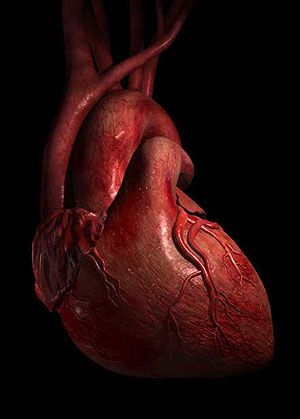 "And I will give them one heart, and put a new spirit within them. And I will take the heart of stone out of their flesh and give them a heart of flesh, that they may walk in My statutes and keep My ordinances and do them. Then they will be My people, and I shall be their God."
- Ezekiel 11:19-20

No comments:
Post a Comment